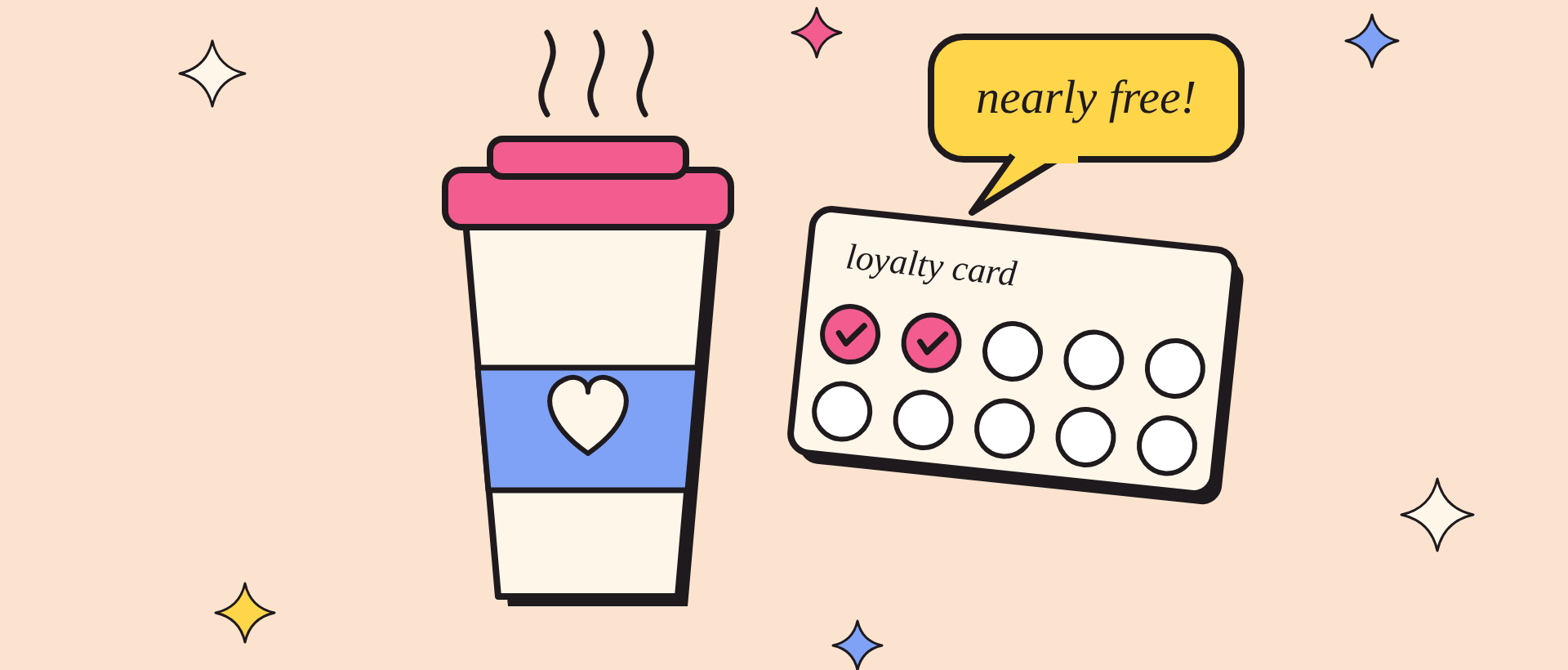
Somewhere right now, a perfectly sensible adult is buying a coffee they don’t want because they’re one stamp away from a free one, and if you asked, they’d tell you they just fancied a coffee.
They’d believe it, too.
I’ve spent about a decade selling things with words, for tech companies, ecommerce brands and plenty of businesses in between, and I’d put that coffee card up against any funnel diagram for explaining why people buy.
Most of us like to think we shop with our heads, weighing up price and features like a well-kept spreadsheet. A lot of the time, though, we’re running on a handful of old, predictable shortcuts, and the sensible explanation turns up afterwards.
The good news for small businesses is that these shortcuts respond to a few well-chosen words in the right place, whatever your budget, which happens to make them my favourite kind of marketing problem. So here are the six I come back to most, along with the copy I’d write for each one, ready for you to borrow.
1. Never let a customer start from zero
That coffee card is the first shortcut, and it’s one researchers have actually measured.
In 2006, researchers studied loyalty cards at a car wash. Some customers received a card requiring eight stamps for a free wash. Others received a ten-stamp card with two stamps already filled in. Both groups still had to purchase eight washes, but the customers who started with two stamps completed their cards faster. The deal hadn’t changed at all. It just felt closer.
People are far more motivated by a goal that’s already under way, so give them a genuine head start. In a café, that might be a couple of complimentary stamps. Online, it could be a welcome checklist with the first step already completed. For a service business, it’s showing a new client what’s already been taken care of, so they feel like they’re on their way before they’ve lifted a finger.
- Before: Buy 8 coffees, get your 9th free.
- After: Your first two stamps are on us. Just 8 more until your free coffee.
2. Give every ask a “because”
If I could keep only one word for selling, it would be “because”, and a photocopier explains why.
In a well-known study from the late 1970s, a researcher tried to skip the queue at a busy photocopier at a New York university. Asking with no reason at all, 60% of people let them go first. Adding “because I’m in a rush” took that to 94%. Adding “because I have to make copies”, which isn’t much of a reason when everyone in the queue is there to make copies, still got 93%.
When the job got bigger, the flimsy reason stopped working, which is a handy reminder that a bigger ask deserves a real explanation.
Small businesses ask for things all day long, from reviews and newsletter sign-ups to deposits and price rises, and every one of those asks gets easier with an honest reason attached. People say yes more readily when they understand why you’re asking, because a request with a reason feels fair.
- Before: Leave us a review!
- After: Leave us a review, because it’s how people nearby find us.
And for the bigger asks:
- Before: Our prices are changing from 1 March.
- After: Our prices are going up from 1 March, because the beans we use cost more this year and we’d rather keep the good ones.
3. Show them who else said yes
Nobody wants to be the only table in an empty restaurant.
When we’re unsure about something, we look at what people like us have done, which is why the busiest stall at a market tends to get busier and why “bestseller” is one of the hardest-working words on any shop page.
The closer the crowd is to your customer, the harder it works. “Thousands of happy customers” is pleasant enough, but “Most first-time customers start with this one” talks straight to the person reading, who is, of course, a first-time customer. A café can do this on the menu board, an online shop on its product pages and a service business right on its pricing page.
The one rule is that it has to be true. Social proof runs entirely on trust, so use real numbers and real favourites, even when they’re less impressive than you’d like.
- Before: Try our signature blend.
- After: The blend most of our regulars order.
People say yes more readily when they understand why you’re asking, because a request with a reason feels fair.
4. Make choosing feel easy
A big menu feels generous right up until you’re standing at the counter with a queue behind you and no idea what a cortado is.
I’ve seen this happen with service packages, too. A business can spend weeks putting together three carefully priced offers, only to leave potential customers wondering which one they actually need. Sometimes, the most useful thing you can write isn’t another benefit or feature. It’s a simple sentence telling someone where to start.
What slows people down is usually how hard the options are to tell apart, especially when they’re in a hurry or don’t yet know what they want. People genuinely like variety, so keep your range and give them somewhere to start.
A café can add a “Not sure? Start here” corner to the board, an online shop can add a “best for beginners” filter, and a service business can add one plain line under each package saying who it’s for, which often does more selling than the whole list of features underneath it.
- Before: Basic, Standard, Premium.
- After: Starter, for testing the waters. Growth, for businesses posting every week. Done for You, for when you’d rather never think about it again.
5. Give something before you ask for anything
Most of us feel a little tug to give something back when someone gives us something first. It’s why free samples work, and why the mint that arrives with a restaurant bill is rarely just about fresh breath.
How you give matters as much as what you give. A tray of samples by the till is nice, but a taste of the new pastry handed to a regular with “try this, I think you’ll like it” feels like a gift, and people remember gifts.
Online, it’s a sample tucked into the parcel with a note about why it was picked for that order. For a service business, it’s one genuinely useful idea sent before the sales call, with no strings attached.
- Before: Would you be open to a quick call to discuss your marketing?
- After: I noticed your checkout asks for a phone number before it shows delivery costs, so here’s a quick fix. Happy to share a few more if they’d help.
6. Make the last moment the best one
We tend to remember an experience by its best (or worst) moment and by how it ended, rather than remembering every moment equally. Psychologists call it the peak-end rule, and it makes the last few seconds with your business worth paying attention to.
In a café, that might be the goodbye: a regular’s name, a “see you tomorrow” or a biscuit on the saucer nobody asked for. For an online shop, it’s the unboxing and the delivery email, and a handwritten note costs pennies. For a service business, it’s a short wrap-up at the end of every project showing what you achieved together, so the last thing a client remembers is the progress they made.
- Before: Your order has been dispatched.
- After: Your order’s on its way, packed by hand this morning. If anything’s not quite right, just reply to this email and a real person will sort it.
Now, back to that coffee
Look at all six together and they’re really one idea: make the decision easier, fairer or nicer for the person making it. A head start makes a goal feel reachable, a reason makes a request feel fair, a crowd makes a choice feel safe, a starting point makes it feel easy, a gift makes it feel personal and a good ending makes it worth coming back for.
All of it fits a small budget, because the main ingredients are attention and a few honest words in the right place.
So pick one, try it this week, and the next time someone buys a coffee they didn’t plan to, you’ll know exactly why.